Healthdirect Australia is not responsible for the content and advertising on the external website you are now entering.
Contraception
15-minute read
Key facts
- There are many contraceptive methods (birth control) that prevent unplanned pregnancy.
- It's important to consider factors such as effectiveness and ease of use to find the best option for you.
- Using birth control methods doesn't affect your fertility, but it may take a few months to return.
- While breastfeeding can be a form of contraception, you can still get pregnant while breastfeeding.
- Talk to your doctor or a family planning clinic to understand which options may be best for you.
What is contraception?
Contraception, also known as birth control, stops a male's sperm from fertilising a female's ovum (egg). By using contraception, you can have sex while preventing an unplanned pregnancy.
Many different types of contraception are available. It is important to choose the method that best suits your needs and your lifestyle. Condoms and the contraceptive pill (sometimes called 'the pill') are popular, but there is a whole range of other options available.
What are the different types of contraception?
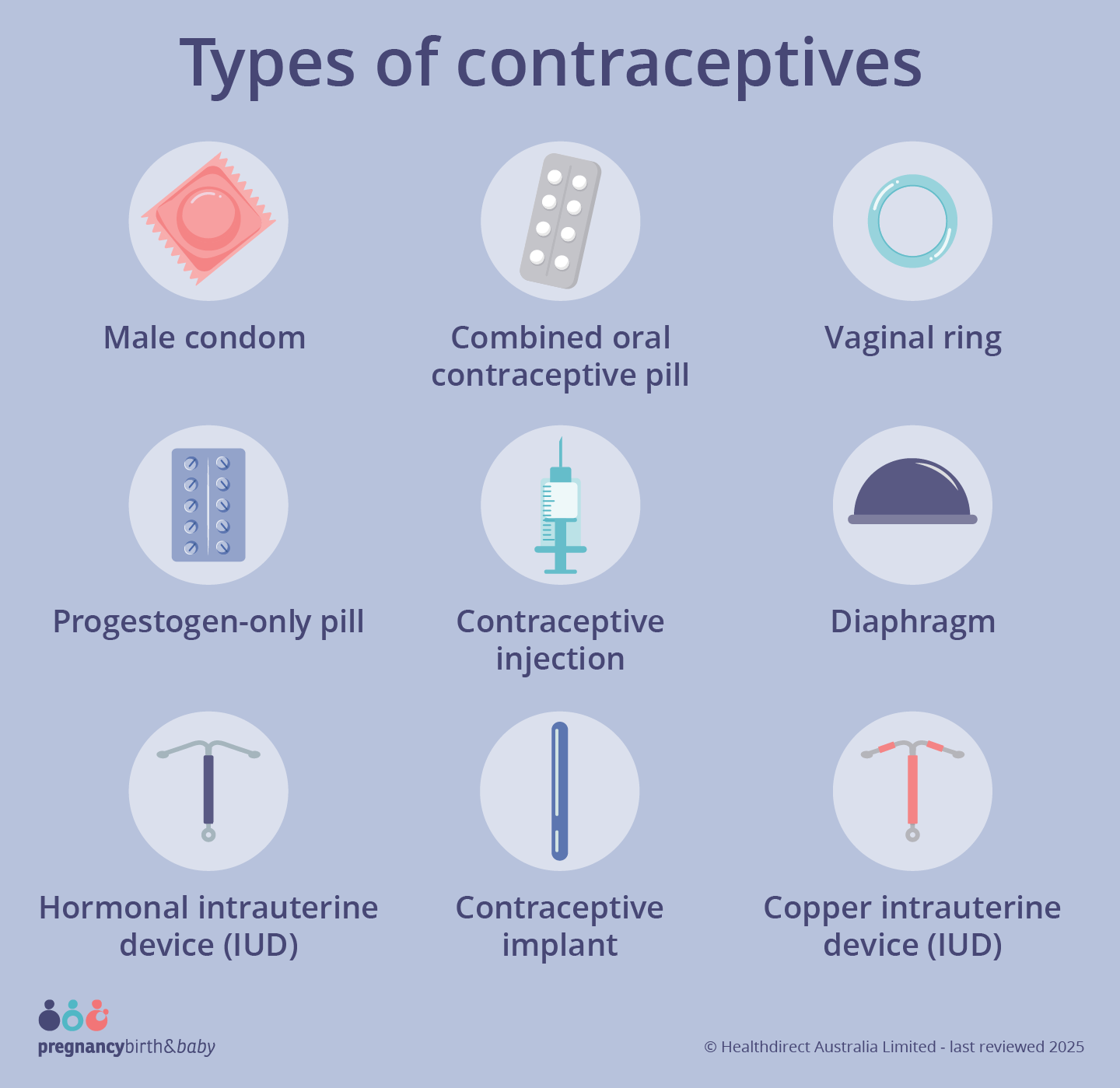
There are many options available for contraceptives that work in different ways.
| Contraception method | Examples |
|---|---|
| Barrier methods | |
| Hormonal contraceptives (shorter-acting) | |
| Hormonal contraceptives (long-acting reversible) | |
| Sterilisation | |
| Natural planning |
|
| Other methods |
|
It is important to choose the method that best suits your needs and lifestyle. When deciding on contraception, you might consider things such as:
- ease of use (how and how often it is taken or changed)
- cost
- effectiveness
- possible side effects
- health conditions or other medicines that might make some methods unsafe or less effective
- risk of sexually transmitted infections (STIs)
- how often you bleed
Your doctor can explain the different options to you and help you choose the one that is best for you.
ASK YOUR DOCTOR — Preparing for an appointment? Use the Question Builder for general tips on what to ask your GP or specialist.
How effective are the different types of contraception?
Different contraceptive methods work differently, and their effectiveness depends on:
- how it works
- how well you take it (for example, remembering to take or use it on time)
Most birth control methods aren't 100% effective, but some methods are more reliable than others. Knowing how effective each option is can help you choose the best one for you.
Long-acting, reversible contraception (LARC) methods include implants and IUDs. They don't rely on your remembering to take or do anything. This makes them more reliable than the pill or condoms. Condoms and the pill are less effective because they can easily be forgotten or not used in the proper way.
Read more about IUDs and contraceptive implants.
When the pill is taken exactly as directed, it is 99% effective. However, in real life, people can forget or miss their pills, so in practice it is less effective, at around 93%.
Read more about the pill.
While contraception is an effective way to prevent pregnancy, it does not usually protect against sexually transmitted infections (STIs). To reduce your risk of getting an STI:
- avoid sex with a partner who could potentially have an STI
- practice safe sex with condoms during penetrative sex
- use dental dams during oral sex
How effective is my contraceptive method?
Types of contraception and how effective they are:
|
Contraception method |
How effective |
|---|---|
|
Implant, IUD, tubal surgery, vasectomy |
More than 99% effective |
|
Contraceptive injection, vaginal ring, the pill |
93 to 99% effective if used perfectly every time |
|
Condom, diaphragm, fertility awareness, rhythm method |
76 to 99% effective |
Do I need to see my doctor to get contraception?
How easy it is to access contraception depends on the method. Some contraception methods are available from a pharmacy with or without a prescription. Others need to be inserted by a trained healthcare professional.
Some types are easier to access than others:
- Condoms are easily available and sold in many places, including supermarkets, pharmacies, petrol stations and often in public toilets.
- The pill is available with a prescription from your doctor or family planning clinic.
- An implant or IUD needs to be inserted by a specially trained doctor or nurse. Speak to your doctor or visit a family planning clinic.
- Emergency contraception, such as the 'morning after pill', can be found at your local family planning clinic or pharmacy without a prescription.
FIND A HEALTH SERVICE — The Service Finder can help you find doctors, pharmacies, hospitals and other health services.
When should I stop taking contraception if I want to get pregnant?
You should consider stopping your contraception when you are ready to become pregnant.
Studies have shown that contraception does not have a long-term effect on your fertility and is safe to use, but some types of contraception can cause a delay before your fertility returns.
For example:
- after you stop taking the pill, it can take around 3 menstrual cycles for your fertility to return
- after removing an IUD, fertility can return quickly
- injectable contraceptives may take up to 6 to 12 menstrual cycles before fertility returns
How soon after having a baby should I start taking contraception?
After a birth, people recover differently and for each person, periods can return at a different pace. You can become pregnant a month before your period restarts — as soon as 3 weeks after having a baby. But, not all types of contraception are safe to use straight after giving birth.
If you want to avoid getting pregnant, it is best to speak to your doctor or midwife before your baby is born about what contraception you will use after the birth. There are options that are both safe and effective after having a baby.
Is breastfeeding an effective form of contraception?
You may have heard that breastfeeding, or the 'lactational amenorrhoea' method (LAM), can be a form of contraception. This is because breastfeeding decreases ovulation (egg release) and can reduce your chance of pregnancy when all these conditions are met:
- You are exclusively breastfeeding day and night.
- You do not give your baby any other food or drink (only breast milk).
- Your baby is younger than 6 months old.
- Your periods have not restarted after giving birth.
Remember that breastfeeding does not guarantee you won't get pregnant. If you are having sex without using contraception — even while you are breastfeeding — you can still become pregnant. Your doctor, pharmacist or maternal health nurse can guide you on the best forms of contraception while you are breastfeeding.
Does contraception affect my baby if I'm breastfeeding?
While you are breastfeeding, there are several safe options for you and your baby, including:
- contraceptive implant
- contraceptive injection
- IUD
- progestogen-only 'mini pill'
The 'mini pill' is preferred during breastfeeding because there is minimal transfer of progestogen through breast milk and it does not affect milk supply. The combined contraceptive pill has not been shown to cause harm to breastfed babies, but can affect milk supply. Some people who are breastfeeding wait until their baby is 6 months old before starting the combined contraceptive pill.
LOOKING FOR A MEDICINE? — To search by brand name or active ingredient, use the Medicines information search feature.
Resources and support
If you or your partner have any questions about contraception, seek advice from a trusted healthcare professional such as your:
- midwife or maternal health nurse
- pharmacist
- doctor
- local family planning clinic
Find a family planning clinic near you.
To learn more about contraceptive methods:
- Read more about contraception on the MSI Australia website.
- View the Jean Hailes pages on contraception.
- Visit the Royal Women's Hospital for information about contraception after birth.
Family Planning Australia has a Yarning About series that breaks down contraception options.
Languages other than English
Family Planning NSW has fact sheets on Women's Health and Contraception in many community languages.
The Royal Women's Hospital has contraception information in other languages.

Speak to a maternal child health nurse
Call Pregnancy, Birth and Baby to speak to a maternal child health nurse on 1800 882 436 or video call. Available 7am to midnight (AET), 7 days a week.