Cots
9-minute read
Key facts
- A cot is a small bed with high sides for your child to sleep and rest safely.
- Cots should meet Australian Product Safety Standards to keep your child safe while they sleep.
- There are ways you can check that your cot meets safety requirements.
- It is important to follow the guidelines on cot dimensions, safe bedding and cot placement to keep your child safe.
What is a cot?
Cots (or cribs) are a contained sleeping environment where children can be left to rest. It is important that cots are safe and secure. There are guidelines in Australia that can help you make sure that your cot is safe for your child.
There are different types of cots available. Sometimes the sides of the cot can be dropped down or can be removed altogether. Some cots have barriers on the sides.
Each cot is made for one child. If you have twins, it is best to put them in separate cots.
What cot should I buy?
In Australia, all new and second-hand cots must comply with Australian Product Safety Standards (Standard AS/NZS 2172:2003).
Not all cots sold meet safety standards, so always check carefully before buying.
You don't need the latest or most expensive model, but whatever cot you choose, make sure it's safe — an unsafe cot can cause injury or even death.
A safe cot can help reduce the risk of:
- getting their fingers, limbs, head or clothes stuck
- suffocation or being strangled
- hitting their head
- climbing or falling out of the cot
Cot safety checklist
When you buy a cot, there are things you can do to check it meets the current safety requirements.
Use a tape measure to check the dimensions of the cot.
Make sure that:
- spaces between the bars of the cot are between 5 centimetres (cm) and 9.5cm
- no parts stick out more than 5cm
- there are no toeholds or footholds above the mattress that could be used for climbing
Gaps can trap your child's limbs, fingers, toes or head. Check that there are no gaps in the cot:
- between 3cm and 5cm
- over 9.5cm
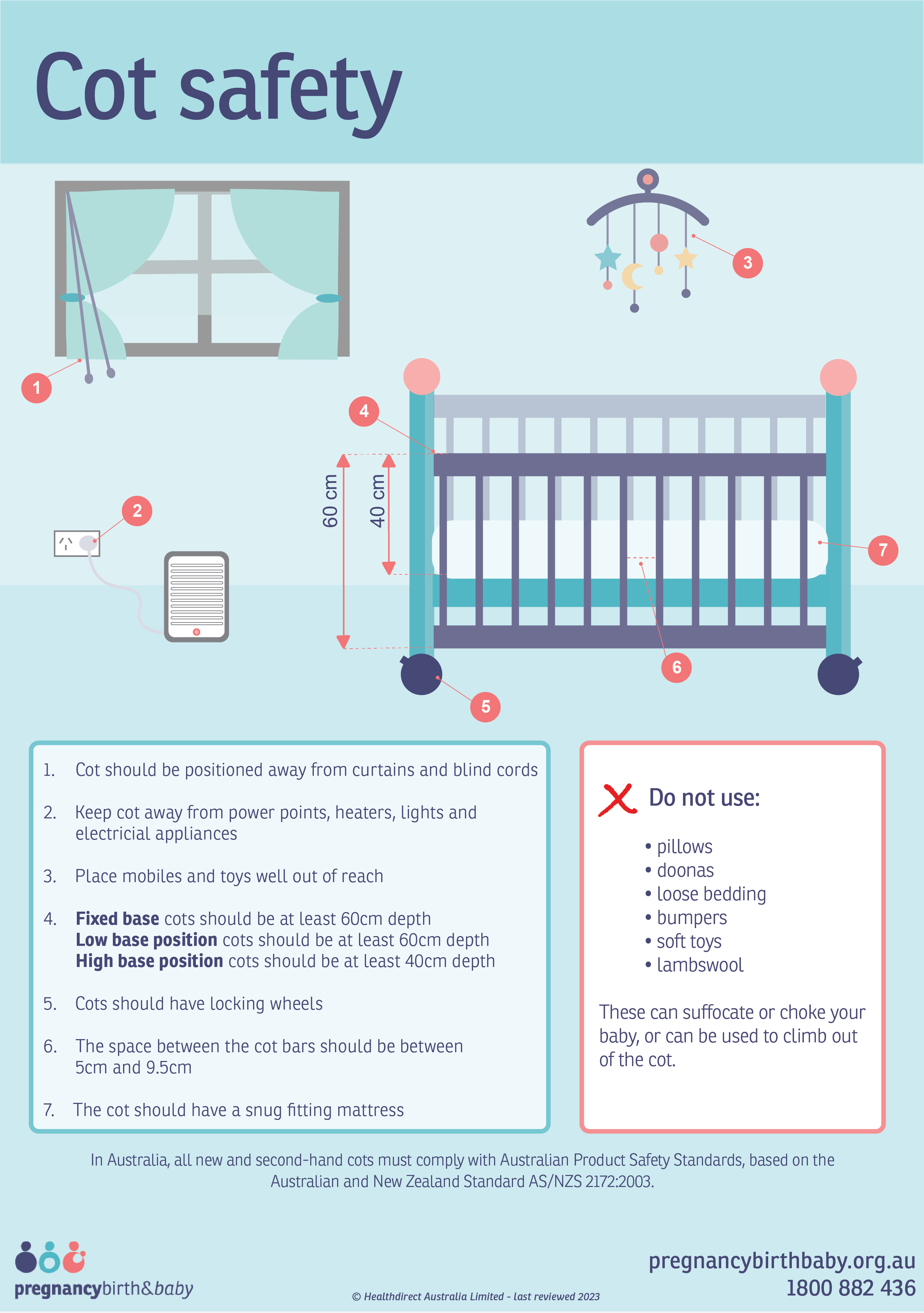
Some cots have a fixed height. Others have an adjustable base, with upper and lower height settings. Follow the product guidelines for your baby's age, size and development. For example, the cot should be set at the upper height for younger babies who cannot sit, pull up or stand. For older babies, it should be set at the lower height so that they cannot fall or climb out.
Guide on how to set up your baby's cot.
Depending on the cot's height, it should be at a certain depth (this is the distance from the base of the mattress to the top of the lowest side):
- Cots with a fixed height should have a depth of at least 60cm.
- Cots set to the lower height should have a depth of at least 60cm.
- Cots set to the upper height should have a depth of at least 40cm.
Should I buy a second-hand cot?
Before you buy or use a second-hand cot, go through the safety checklist. Just because someone else owned the cot before you, it does not mean that it is up to current safety standards.
There are a few different rules for used or second-hand cots:
- parts sticking out can be up to 8cm long
- gaps between 3cm and 5cm are allowed
- they do not require safety labels
You should only use a second-hand cot:
- with all parts in good working order
- that comes with full instructions to set it up safely
If there are any broken or loose bars, make sure they are repaired before your baby sleeps in the cot.
It is also important to check old cots for poisonous lead-based paint.
What mattress should I buy for my baby's cot?
When choosing a mattress for your baby's cot, it is important to follow safety regulations.
Babies should sleep on a firm mattress. Soft ones can be dangerous, because they:
- make it easier for your baby to roll over
- become more uneven as your baby gets heavier
- increase the risk of suffocation, strangulation or sudden unexpected infant death syndrome
It is important to choose a mattress that is firm and fits the cot well.
The space between the mattress and the sides of the cot should be:
- no more than 2cm when the mattress is in the centre of the cot
- no more than 4cm when the mattress is pushed to the side of the cot
Plastic wrapping can suffocate a baby or young child. Make sure you remove all plastic wrapping from a new mattress.
What bedding should I use in my baby's cot?
Some types of bedding may be unsafe for babies. You should be very careful that the bedding:
- cannot cover your baby's face
- cannot block their breathing
A good choice of bedding is an infant sleeping bag, with:
- a fitted neck
- armholes
- no hood
If you are using blankets, make sure they:
- are tucked firmly into the mattress at the base
- do not come up further than your baby's chest
Place your baby with their feet at the base of the cot.
Do not put loose items in the cot, such as:
- pillows
- doonas
- loose bedding
- lambswool or sheepskin
- bumpers
- soft toys
These may:
- be used as climbing aids
- cause choking
- suffocate your baby
What are portable cots?
Portable cots are designed to be used temporarily. They can be helpful when you are travelling or visiting.
They might not be as safe as permanent cots, because they can fold, which makes it easier for children to climb out of them or become trapped.
Only use a portable cot if it meets the Australian Safety Standards. These are based on the Australian and New Zealand Standard AS/NZS 2195:1999. Make sure:
- it works properly
- it has a locking mechanism to stop it from collapsing
- you set it up by following the instructions exactly, so it does not collapse
Do not use a thick mattress or an extra layer in a portable cot. This is because your baby could get trapped between the mattress and the stretchable cot side. Make sure you use a mattress that matches the cot's dimensions.
Only use a portable cot if your baby weighs less than 15 kilograms (kg).
Where should I put my baby's cot?
When you bring the cot home, place it:
- away from the curtains, blind cords and other cords or ropes in which your baby could get tangled
- where mobiles and toys are well out of reach
- against walls that do not have pictures or mirrors that could fall and injure your baby
The cot should be away from:
- power points
- heaters
- electrical appliances
- lights
If your baby is less than 6 months old, you should place their cot in your room.
Make sure your baby is in a smoke-free environment.
Resources and support
For more information on cots and sleep safety, you can visit:
- the Australian Competition and Consumer Commission for information about mandatory safety standards for cots and baby products
- Red Nose for a guide on safe sleeping practices to reduce the risk of sudden unexpected death in infancy (SUDI)
- Australian Children's Education & Care Quality Authority for resources on national quality standards, including safe sleep practices
- StartingBlocks for practical tips for parents about choosing safe products and creating safe sleep environments for babies
- Consumer Protection Western Australia for advice on product recalls and cot safety requirements
Information for Aboriginal and/or Torres Strait Islander peoples
- Product Safety Australia has information and a video called Sleep Bub Safe.
- Red Nose has information on safe sleeping practices.

Speak to a maternal child health nurse
Call Pregnancy, Birth and Baby to speak to a maternal child health nurse on 1800 882 436 or video call. Available 7am to midnight (AET), 7 days a week.